
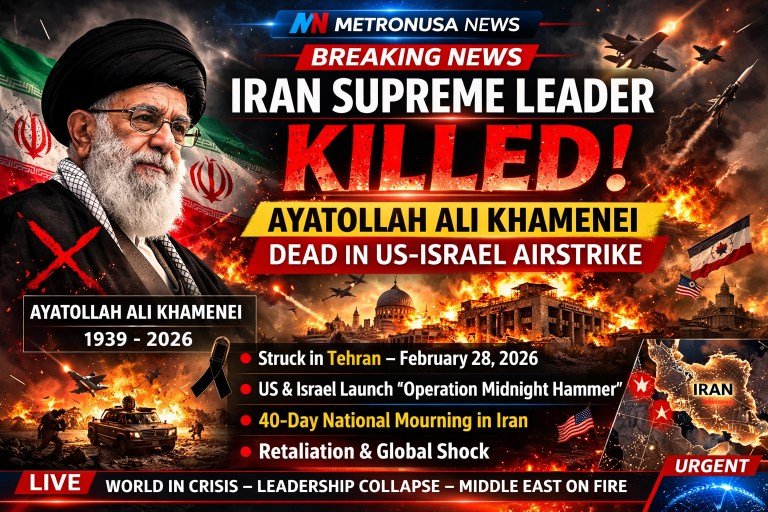
MetronusaNews.id | Tehran, Iran – March 1, 2026 — Iran’s Supreme Leader, Ayatollah Ali Khamenei, has reportedly been killed following a large-scale military strike carried out by the United States and Israel on February 28, 2026. Iranian state media confirmed his death on Sunday, describing him as having “achieved martyrdom” after an airstrike targeted a high-security complex in central Tehran.
The attack was part of a broader coordinated military operation aimed at key strategic and leadership targets within Iran. Prior to the official confirmation, senior Israeli and U.S. officials had indicated there were “strong signs” that Khamenei did not survive the strike.
National Mourning and Immediate Response
Following the announcement, the Iranian government declared a 40-day national mourning period. Crowds reportedly gathered in several parts of Tehran to mourn the long-time leader, while senior Iranian officials condemned the attack and vowed retaliation.
Reports also indicate that several high-ranking Iranian military officials were killed in the same wave of strikes, intensifying the leadership crisis within the country.
Leadership Transition and Political Uncertainty
Khamenei’s death marks a historic turning point for the Islamic Republic of Iran. Under the Iranian constitution, a temporary leadership council is expected to assume authority until a new Supreme Leader is selected by the Assembly of Experts.
Political analysts warn that the sudden loss of Iran’s highest authority could significantly reshape regional geopolitics and escalate the ongoing conflict between Iran, Israel, and the United States.
Background
Ayatollah Ali Khamenei, 86, had served as Iran’s Supreme Leader since 1989, succeeding Ayatollah Ruhollah Khomeini. Over more than three decades, he held ultimate authority over Iran’s military, foreign policy, and religious institutions, and was widely regarded as the most powerful figure in the country.
His leadership was marked by deep tensions with Western nations, particularly the United States and Israel, as well as Iran’s expanding regional influence through allied groups across the Middle East.