
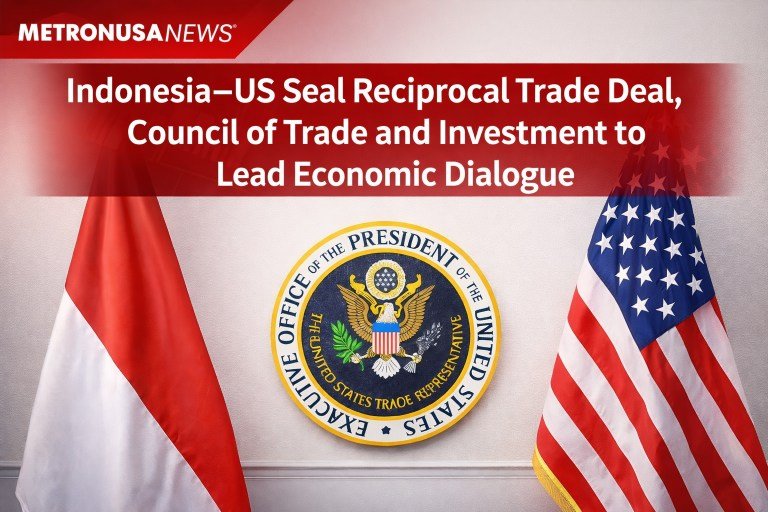
MetronusaNews.id | Washington, DC – The Government of Indonesia and the Government of the United States have officially signed a Reciprocal Trade Agreement titled “Toward a New Golden Age for the US–Indonesia Alliance” in Washington, DC, on Thursday (February 19, 2026).
The agreement marks a new chapter in bilateral economic relations, reinforcing both nations’ commitment to strengthening trade and investment cooperation based on mutual benefit and balanced market access.
As part of the deal, both countries agreed to elevate the Council of Trade and Investment (CTI) as the primary forum for bilateral economic dialogue. The CTI will serve as a high-level platform to address trade issues, investment facilitation, regulatory alignment, and strategic economic cooperation on a regular basis.
Promoting Balanced and Open Trade
The reciprocal trade framework aims to expand market access for key products from both countries while gradually reducing tariff and non-tariff barriers. The principle of fairness and shared economic gains underpins the implementation of the agreement.
The initiative is expected to boost bilateral trade volume, widen export opportunities for Indonesian products, and create a more transparent and predictable investment climate.
Focus on Strategic Sectors
The strengthened economic cooperation between Indonesia and the United States will prioritize several key sectors, including:
-Critical minerals supply chains and downstream industrial development;
-Clean energy and energy transition initiatives;
-Digital economy and technological innovation;
-MSME empowerment and export capacity building.
Through the enhanced role of the CTI, both governments also committed to constructively addressing technical trade barriers and accelerating investment realization in priority sectors.
Strengthening a Long-Term Strategic Partnership
The United States remains one of Indonesia’s key trading partners and investors. With the signing of this agreement, both nations aim to deepen long-term economic collaboration that is inclusive, sustainable, and adaptive to global economic dynamics.
The Indonesian government views the agreement as part of its broader strategy to expand global market access while reinforcing Indonesia’s position within global supply chains.